Hurry! Measure the QTc quickly on the ECG!
Emergency room, triage, urgency: syncope or a polymedicated patient requires mandatory evaluation of the QT interval in addition to the ECG tracing analysis itself. However, calculating the QT on the ECG under these circumstances is naturally counterproductive. Faster ways to obtain the necessary information (Is the QTc prolonged? Is this patient at risk of developing torsades de pointes due to a prolonged QTc?) should exist. And they do: pay attention here.
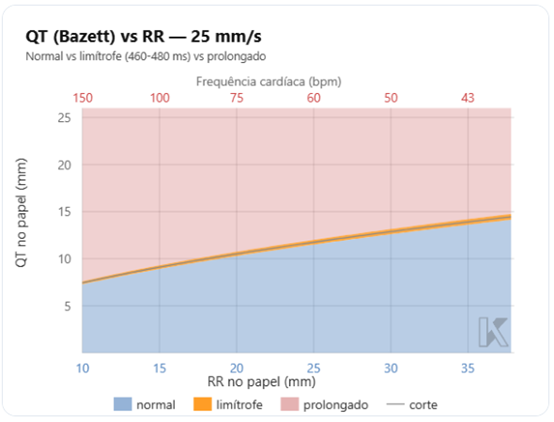
At the beginning of 2026 we are proud to announce something unprecedented regarding the QT interval and its heart-rate–corrected measurement. We have just created a tool that provides the graph of the QT interval integral for all possible heart rates, but plotted in millimeters. This approach has two advantages:
- 1) The graph becomes “rectified”, no longer following the classic exponential curve seen in Bazett, Fridericia, and other formulas. This allows intuitive visualization of whether the QT measured in mm is outside the normal range.
- 2) The QTc can still be calculated in the same place through the following application:
We will demonstrate the advantages below:
Bazett nomogram in millimeters
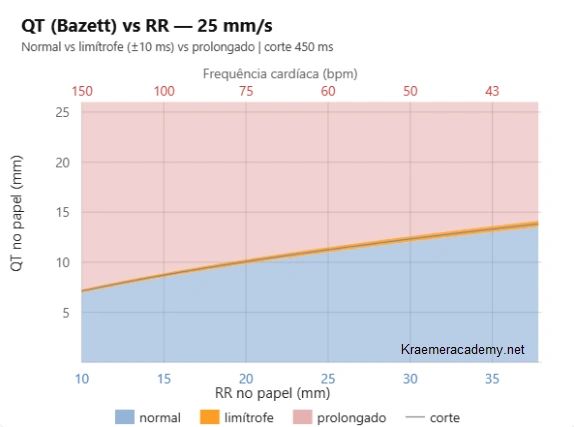
Note that you only need to look at the QT interval on the ECG and the RR interval (heart rate expressed in mm) and place these points on the graph corresponding to your preferred QT correction formula. If the marked point falls in the red zone of the graph, you are discovering that your patient has a prolonged QTc without needing to use formulas, a calculator, or even convert measurements into milliseconds or beats per minute. If the point falls in the blue zone of the graph, you are automatically identifying that your patient belongs to the “normal QTc” group, helping speed up emergency room triage and optimize patient care without neglecting QT measurements—often overlooked in these settings when a specialist is not available.
Use the application:
https://qtc.mocha.app
to obtain these nomograms for free. The main formulas are available there, formatted as nomograms in millimeters. However, if you are curious, these nomograms are also available in milliseconds and beats per minute.
Enjoy! It is free and also useful for learning and training.
Learn more Kraemer Academy